Relying solely on a simple sieve analysis without the hydrometer fraction is a mistake we see repeatedly in Cape Coral, where the surface sand often masks a significant silt and clay matrix at depth. The Tamiami Formation underlying much of the city produces fine carbonate muds and silty sands that control permeability and compaction behavior. A full grain size distribution curve—from coarse sand through the silt fraction down to clay colloids—is the only way to assign a proper USCS group symbol and predict how the material will perform under foundation loads or as structural fill. We run the complete mechanical sieve stack plus sedimentation analysis per ASTM D6913 and D7928 in our AASHTO-accredited soils laboratory, delivering a continuous particle-size curve that informs Atterberg limits correlation and Proctor compaction target values for Cape Coral earthwork specifications. The split between sand and fines determines everything from drainage design to lateral earth pressure coefficients on retaining walls along the city's canal-front properties.
A clean-sand assumption in Cape Coral fails when the hydrometer reveals 15 to 40 percent fines—a difference that changes everything from compaction spec to drainage design.
Scope of work in Cape Coral
Working video
Typical technical challenges in Cape Coral
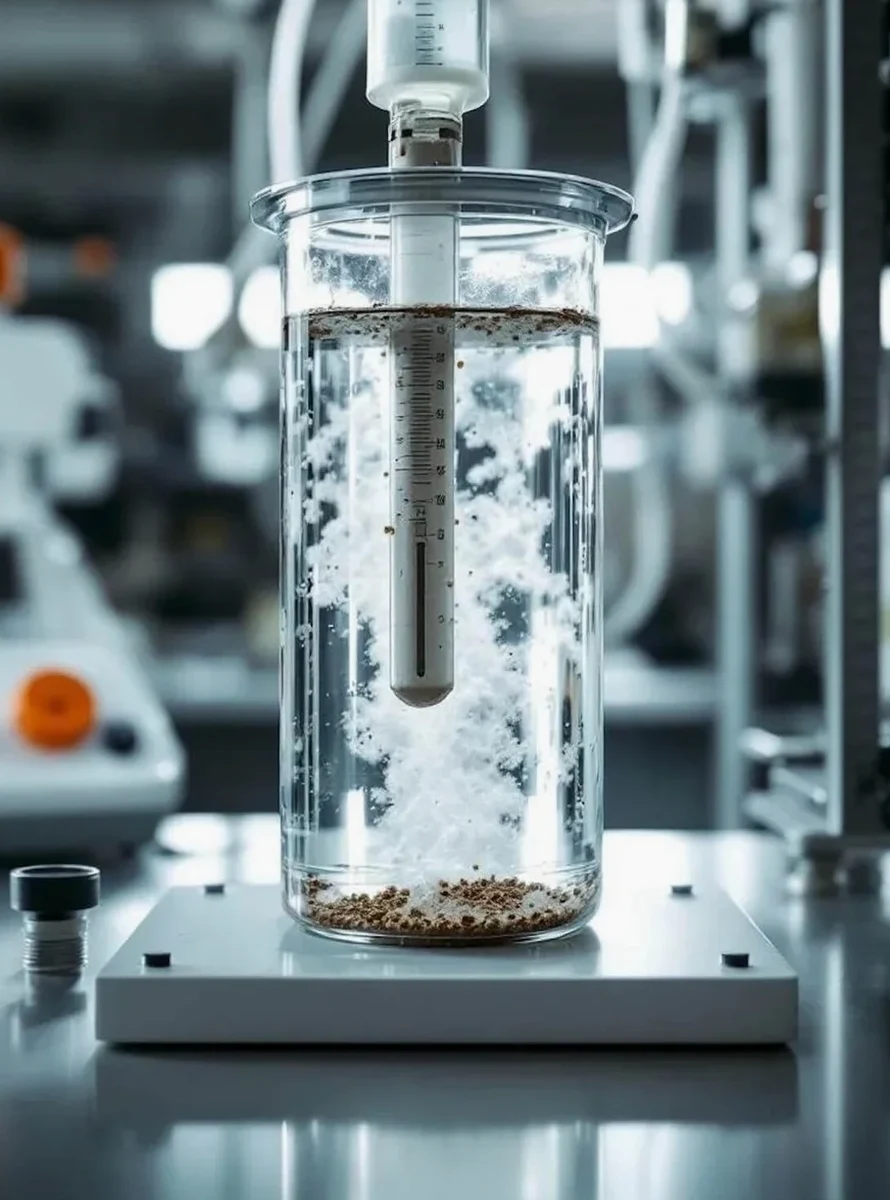
The sedimentation cylinder and ASTM 152H hydrometer are the heart of the fine-fraction analysis, and their handling demands strict temperature control—a challenge in a Cape Coral field lab trailer during August when ambient air hits 95°F and the water bath wants to drift. We run the hydrometer test inside a constant-temperature bath at 20 ± 0.5°C, because a two-degree swing shifts the apparent clay fraction enough to misclassify a silty sand as a clayey sand. The bigger risk is skipping the hydrometer entirely and reporting just the sieve portion. In Cape Coral, where the geologic column includes the Fort Thompson Formation and overlying organic silts, a sieve-only analysis routinely misses 15 to 40 percent of the total sample mass. That blind spot leads to undersized stormwater infiltration systems, mischaracterized subgrade for pavement design, and retaining wall backfill that drains poorly and builds pore pressure during the summer wet season. The hydrometer reading at 24 hours is not optional; it is the difference between a pavement section that lasts fifteen years and one that fails after three.
Our services
The grain size distribution curve is rarely an isolated deliverable. Our Cape Coral laboratory packages the sieve and hydrometer analysis with complementary index and performance tests so the geotechnical report is internally consistent and ready for regulatory submission to the City of Cape Coral Building Division or the South Florida Water Management District. Each service below runs on the same sample split to eliminate inter-specimen variability.
Full Gradation Suite (Sieve + Hydrometer)
Complete mechanical sieve analysis from 3 inches to No. 200 combined with ASTM D7928 hydrometer sedimentation. Delivered as a semi-log gradation plot, USCS group symbol and name, Cu, Cc, D10-D30-D60, and percent gravel/sand/silt/clay by dry mass.
Washed Sieve Analysis (No. 200 Wash)
For soils where the hydrometer is not specified but accurate total fines content matters. We wash the sample through a No. 200 sieve, oven-dry the retained fraction, and report the percent passing by mass difference. This catches the fines that dry-sieving misses due to particle adhesion.
Correlated Atterberg Limits Package
On the same split used for hydrometer analysis we run ASTM D4318 liquid limit, plastic limit, and plasticity index. The combined gradation-plasticity data set places the soil definitively on the Casagrande plasticity chart and resolves borderline USCS classifications common in Cape Coral silty sands.
Quick answers
When does a Cape Coral project require a hydrometer analysis instead of just a sieve test?
Any time the material passing the No. 200 sieve exceeds 5 percent of the total sample mass, ASTM D2487 requires the hydrometer to determine the silt-versus-clay split. In Cape Coral's Tamiami and Fort Thompson formations, that threshold is exceeded on roughly 70 percent of the borings we process. Stormwater infiltration designs submitted to SFWMD also routinely require the full particle-size distribution curve for permeability estimation.
How does the local carbonate geology affect the grain size analysis?
Cape Coral sits on shallow marine and estuarine sediments rich in calcium carbonate from shell fragments and limestone weathering. The carbonates can flocculate during hydrometer testing if the dispersant concentration is insufficient. We adjust the sodium hexametaphosphate dosage based on the sample's reaction to dilute HCl and run parallel checks when the carbonate content appears high, ensuring the clay fraction is not artificially inflated by aggregated silt-sized carbonate particles.
What does a combined sieve and hydrometer test cost for a Cape Coral project?
A full ASTM D6913 plus D7928 analysis on a single sample typically ranges from US$110 to US$220, depending on the number of sieves requested, whether the sample requires oven-drying and disaggregation of cemented carbonate clasts, and turnaround time. Projects with multiple samples benefit from batch pricing.