Driving a tunnel from the established neighborhoods near Cape Coral Parkway versus cutting through the younger fill zones out by the expanding northwest sector presents two completely different soil profiles, even though both sit barely ten feet above sea level. The difference is in the matrix beneath the surface. In the older southern sections of Cape Coral, you often hit cemented shell layers and sandy limestone pockets that hold an arch reasonably well during excavation. Move a few miles north into Cape Coral's newer developments, and the stratigraphy shifts to loose silty sands and organic silts that slump the moment they lose capillary tension. Our laboratory sees the consequences of misreading Cape Coral's geology on a regular basis, which is why we approach every tunnel project with a site-specific program of classification and strength testing under saturated conditions. Before committing to a tunnel boring machine or sequential excavation method, we typically advise a complementary CPT investigation to map the soft zones continuously, since SPT alone can miss thin clay seams that control face stability in Cape Coral's coastal plain deposits. The real challenge with Cape Coral isn't just the soft ground; it's the water table sitting at four to six feet below grade, year-round, and the way the local limestone can dissolve into solution channels that no standard borehole grid will detect unless you know to look for them.
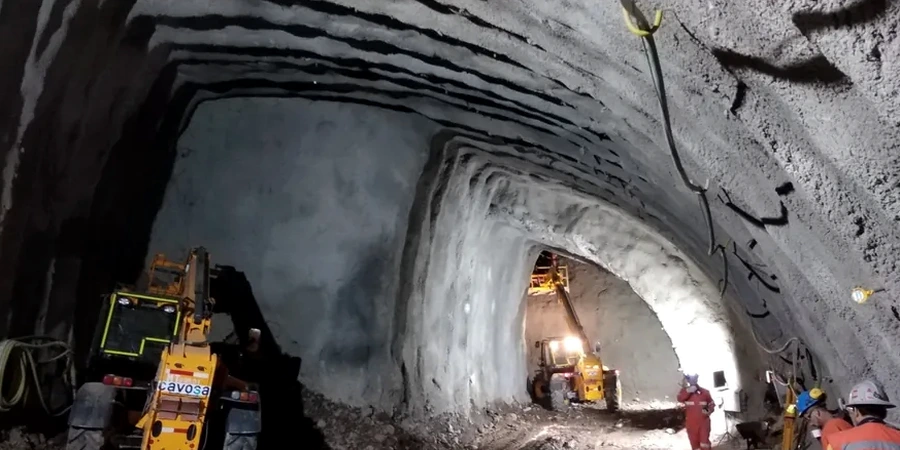
Tunneling in Cape Coral means designing for saturated granular soils with zero stand-up time and pore pressures that never fully dissipate.
Scope of work in Cape Coral
Working video
Typical technical challenges in Cape Coral
IBC Chapter 18 and ASCE 7-22 require a thorough geotechnical investigation for any tunnel classified as a buried structure, and in Cape Coral the specific concern is loss of ground due to running or flowing soil conditions under hydrostatic pressure. The Florida Building Code, which adopts IBC with state-specific amendments, explicitly addresses the need for dewatering analysis in high-water-table environments like Cape Coral. If the face pressure in a pressurized-face TBM drops below the in-situ pore pressure for even a few seconds, the saturated sands of Cape Coral will flow into the cutterhead, creating a void that propagates rapidly upward through the shallow overburden. We've modeled scenarios where a face loss of less than one cubic meter in Cape Coral's fine sands results in a surface settlement trough exceeding fifty millimeters within twenty-four hours, because the soil has practically no arching capacity when saturated. Add the complication of solution-weathered limestone horizons that can act as preferential drainage paths, and you have a tunnel alignment where groundwater control isn't just a construction convenience; it's the primary factor keeping the street above from collapsing into the heading. Our laboratory testing program for Cape Coral tunnel projects always includes soil-water characteristic curves and consolidated-drained strength parameters, because effective stress analysis is the only reliable framework for predicting face stability in these conditions.
Our services
Our geotechnical laboratory in Cape Coral provides the complete testing package needed to characterize soft ground for mechanized and conventional tunneling. Every test program starts with a conversation about your alignment and the geomorphic units it crosses, because the testing suite for a tunnel under the Caloosahatchee floodplain differs substantially from one staying within the Pine Island formation.
Advanced Triaxial Testing
CU and CD triaxial tests with back-pressure saturation and pore pressure measurement. We test Cape Coral soils at the in-situ density and moisture content they'll have at tunnel depth, because remolded strength values are meaningless for face stability calculations.
Soil Classification and Index Properties
Full particle-size distribution by sieving and hydrometer, Atterberg limits, and carbonate content determination. The shell fraction in Cape Coral soils affects TBM tool wear and requires separate quantification beyond standard ASTM D2487 classification.
Permeability and Consolidation Testing
Falling-head and constant-head permeability tests on remolded and undisturbed specimens, plus one-dimensional consolidation for estimating time-dependent settlements above shallow tunnels in Cape Coral's compressible organic silts.
Groundwater and Pore Pressure Analysis
We install vibrating-wire piezometers and monitor tidal influence on groundwater levels over multiple lunar cycles before finalizing your tunnel face pressure envelope. Cape Coral's canal network creates a dynamic hydraulic boundary that static water table assumptions miss entirely.
Quick answers
What is the typical cost range for a geotechnical analysis supporting a soft soil tunnel in Cape Coral?
How do you handle the high groundwater table in Cape Coral during tunnel geotechnical investigations?
We use mud-rotary drilling to stabilize boreholes below the water table and recover undisturbed samples using Shelby tubes and piston samplers where the soils are cohesive enough. In the loose sands common to Cape Coral, we rely on SPT sampling and CPT soundings to characterize density, then reconstruct specimens in the laboratory at the in-situ density and saturation. Piezometers are installed and monitored for at least two weeks, and we correlate readings with tidal cycles in the Caloosahatchee and the canal network, because the hydraulic boundary conditions shift daily.
What laboratory tests are most critical for tunneling through Cape Coral's soft limestone and sand layers?
The three tests we consider non-negotiable are: consolidated-undrained triaxial with pore pressure measurement for the cohesive layers, particle-size distribution with hydrometer to quantify the silt and clay fraction in the sands, and carbonate content by acid digestion to assess the shell hash that causes TBM cutter wear and re-cementation inside the excavation chamber. If the alignment crosses any organic silt deposits, we add one-dimensional consolidation tests to estimate long-term surface settlement.
How long does a full geotechnical laboratory program for a Cape Coral tunnel project take?
From the day samples arrive in our laboratory, a complete program including classification, triaxial, consolidation, and permeability testing on samples from a typical Cape Coral alignment takes four to six weeks. Consolidation tests on the organic silts run the longest because each load increment requires near-complete primary consolidation before the next step. We can provide preliminary classification and index data within one week to support early-stage TBM selection decisions while the strength and consolidation tests continue.