With over 400 miles of navigable canals and an average elevation barely six feet above sea level, Cape Coral presents a unique challenge for deep foundation improvement. The city sits on a blanket of Pleistocene and Holocene sands, often loose and saturated, making vibrocompaction the go-to solution for densification. In our experience, projects near the Caloosahatchee River or the spread-out canal network demand a design that anticipates not just settlement but also potential liquefaction during a major storm event. Getting the vibrator probe frequency and grid spacing right from the start avoids costly rework later, especially when building on soils that can lose strength fast under cyclic loading. We combine CPT testing early in the design phase to map the sand lenses precisely and calibrate the compaction energy needed for each zone.
In Cape Coral's loose canal-side sands, effective vibrocompaction design isn't about applying maximum energy—it's about matching frequency to the soil's natural grain-size distribution.
Scope of work in Cape Coral
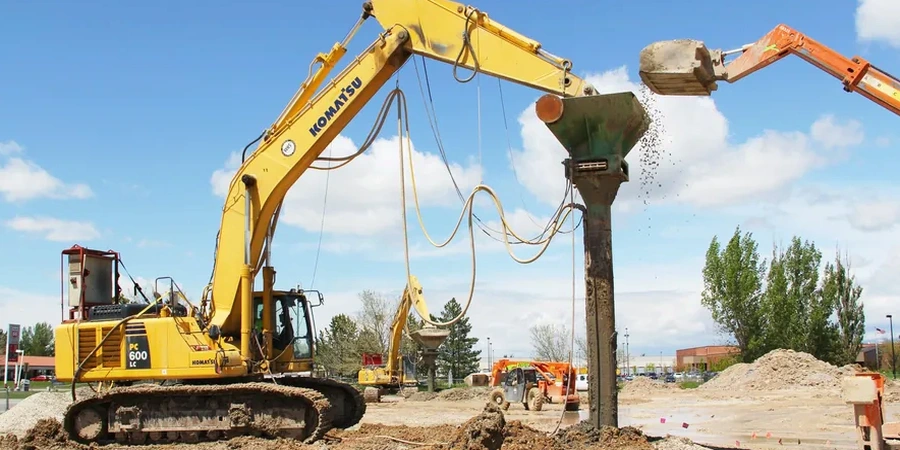
Typical technical challenges in Cape Coral
Comparing the established neighborhoods south of Pine Island Road with the newer developments in the northwest Cape, the soil risk profile shifts noticeably. The southern areas, developed decades ago on dredged fill, often contain a chaotic mix of loose sand and silty debris that responds unevenly to vibrocompaction—some zones densify well, while adjacent spots barely improve. In the northwest, the native sands are cleaner and more predictable, but the proximity to conservation lands and wetlands means you're dealing with higher organic content and softer transitions. Without a site-specific design, you risk differential settlement that cracks slabs and tilts pool decks within the first two hurricane seasons. A thorough pre-design investigation identifies these micro-zones so the compaction grid and energy can be tailored block by block.
Our services
Our vibrocompaction design service in Cape Coral covers everything from feasibility assessment to quality control specifications, always adapted to the local geology and Florida Building Code requirements.
Site-Specific Vibrocompaction Design
Development of probe spacing, grid pattern, and energy parameters based on CPT and SPT data from the exact project lot. We define lift thicknesses for backfill, water jetting pressure, and real-time monitoring criteria to achieve uniform densification across the treatment area.
Pre- and Post-Treatment Verification
Execution of SPT borings or CPT soundings before and after vibrocompaction to quantify the improvement in relative density. Our reports compare N-values and tip resistance against design targets, providing documentation for building officials and geotechnical engineers of record.
Quick answers
What does vibrocompaction design typically cost for a residential lot in Cape Coral?
How does the high water table in Cape Coral affect vibrocompaction performance?
The shallow groundwater in Cape Coral actually benefits the vibrocompaction process. Water acts as a lubricant between sand grains, allowing them to rearrange more efficiently under vibration. Our designs take advantage of this by timing treatments during the wet season when saturation is highest, which typically yields better densification with fewer passes.
Can vibrocompaction be used near existing canal seawalls without causing damage?
Yes, but it requires careful design. We establish exclusion zones and monitor vibration levels near seawalls and adjacent structures. The probe spacing is tightened near the canal edge to reduce energy per point while still achieving compaction. In some cases, we specify a reduced frequency setting to stay below peak particle velocity thresholds that could disturb older concrete seawalls.