The biggest mistake we see in Cape Coral is treating a retaining wall like a standard gravity structure without accounting for the hydrostatic pressure that builds up behind it. This city sits on a network of over 400 miles of canals, and the groundwater is often sitting just a couple of feet below the surface. You excavate for a footing and the hole fills with water within minutes. Standard drainage provisions that work in clay soils of the Midwest simply do not cut it here. Before touching a wall design, we run a grain-size analysis to confirm the fine sand content, and we pair it with in-situ permeability testing to calculate the actual flow rate the drainage system must handle. Without that data, you are guessing, and in Cape Coral, guessing means a wall that leans, cracks, or blows out after the first heavy rainy season.
In Cape Coral, a retaining wall fails from the backside first. If you do not control the water, the wall is just a temporary barrier.
Scope of work in Cape Coral
Typical technical challenges in Cape Coral
Walk along any older canal in Cape Coral after a tropical storm and you will spot the same pattern: walls with horizontal cracks at the mid-height, outward tilting of the top course, or scoured soil visible through open joints. Nine times out of ten, the culprit is not the wall itself but the drainage system behind it. The fine calcareous sand that dominates the area has a nasty habit of migrating into weep holes and clogging them over time, especially when the backfill was not wrapped in a proper filter fabric. We specify graded aggregate drains with a minimum 12-inch thickness and a geotextile that meets AASHTO M288 Class 2 retention criteria. For walls over six feet, we require a perforated collector pipe at the base with a positive outfall to the canal or storm system. The city's flat topography, with elevations ranging from sea level to about 15 feet, means gravity drainage is limited, so we often integrate a sump pump bypass for the wettest months from June through September.
Our services
Our retaining wall design scope in Cape Coral covers everything from preliminary geotechnical investigation through final construction drawings and construction-phase observation. Each project includes a site-specific lateral earth pressure analysis, global and internal stability checks, and a drainage design that accounts for the seasonal high water table.
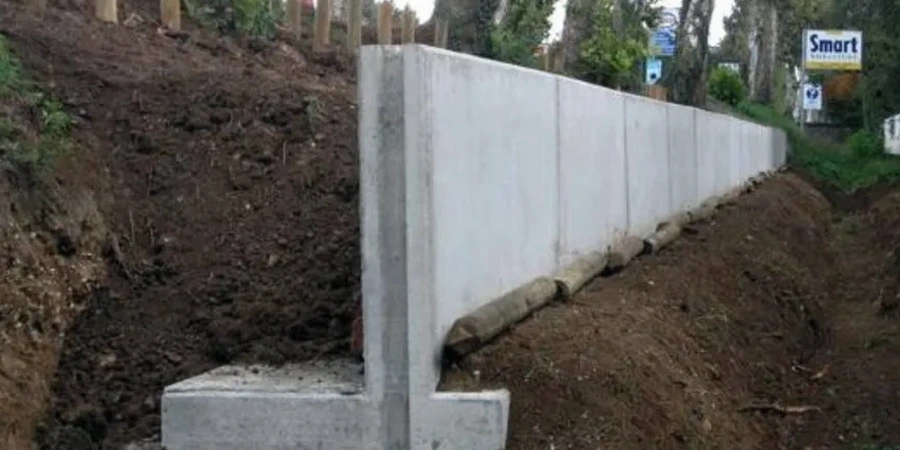
Cantilever and Gravity Wall Design
Reinforced concrete and masonry gravity walls up to 12 feet in height, with stem, toe, and heel proportioning based on the actual φ' and γ values from site-specific laboratory testing.
Sheet Pile and Soldier Pile Walls
Steel sheet pile and soldier pile with lagging walls for canal-front properties where excavation space is limited and lateral support is needed during construction below the water table.
Segmental Block Wall (SRW) Design
Geogrid-reinforced segmental retaining walls for residential and commercial landscaping, with internal stability analysis per NCMA design guidelines and global stability checks using Spencer's method.
Drainage System and Filter Design
Design of graded aggregate drains, geotextile filter specifications, and collector pipe networks sized for the 25-year, 24-hour storm event per Southwest Florida Water Management District criteria.
Quick answers
What is the typical cost range for retaining wall design in Cape Coral?
For a residential canal-front wall under six feet in height, the engineering design and geotechnical investigation typically range from US$960 to US$3,720 depending on the wall length, access conditions, and whether SPT drilling or test pit exploration is required. Larger commercial walls with soldier piles or tieback anchors fall on the upper end of that range due to the additional analysis and detailing involved.
How does the high water table in Cape Coral affect retaining wall stability?
The water table in Cape Coral is often within two to four feet of the ground surface during the wet season, which dramatically increases the lateral pressure acting on the wall. We account for this by using the buoyant unit weight of the soil below the water table and adding the full hydrostatic pressure to the lateral earth pressure diagram. Without an effective drainage system, the wall must resist roughly double the force compared to a dry backfill condition.
Do I need a building permit for a retaining wall in Cape Coral?
Yes, the City of Cape Coral requires a building permit for any retaining wall over two feet in height, measured from the bottom of the footing to the top of the wall. The permit application must include a signed-and-sealed geotechnical report with boring logs, groundwater data, and a structural design sealed by a Florida-registered professional engineer. Walls adjacent to canals also require an environmental resource permit from the Florida Department of Environmental Protection if they are within the jurisdictional wetland line.