In Cape Coral we see foundations that look fine on the surface but the underlying soil tells a different story. The water table sits barely two feet down across much of the city. That changes everything when you are specifying isolation bearings. We run the laboratory program first—cyclic shear on the elastomer, compressive stiffness verification, prototype testing under axial load plus lateral displacement—because no manufacturer’s catalog can account for the local sand-and-limestone profile. A proper seismic microzonation study gives us the spectral demand at the isolation plane. Combine that with CPT testing through the upper 30 meters and you have real numbers to feed into the bearing design, not generic site class assumptions.
An isolation bearing is only as reliable as the soil stiffness profile you feed into the time-history analysis—get the Vs wrong and the isolator period misses the target.
Scope of work in Cape Coral
Typical technical challenges in Cape Coral
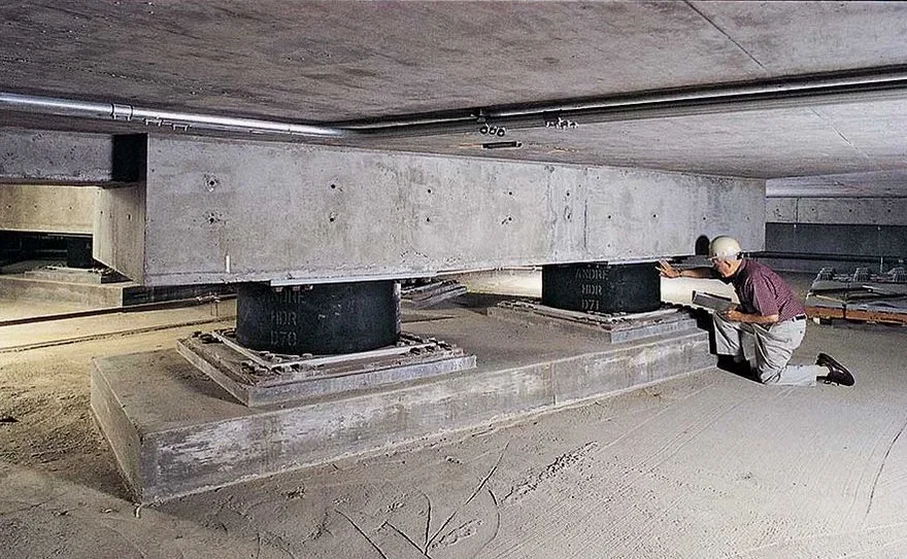
Cape Coral’s combination of shallow groundwater and loose-to-medium dense sand creates a specific risk for isolated structures: the moat wall that allows the building to move laterally during an earthquake must stay dry and clear of debris over the building’s service life. Water intrusion corrodes the bearing plates. Sand accumulation locks the gap. We specify stainless steel shim plates and neoprene cover seals tested under salt-spray conditions per ASTM B117. Another risk is scour around the foundation perimeter during hurricane storm surge—the isolation plane must remain above the 500-year flood elevation plus freeboard per FEMA guidelines for coastal A-zones. Our report includes a drainage and waterproofing detail package specific to each bearing type and site elevation.
Our services
Our Cape Coral laboratory program covers the full testing sequence needed for peer review submission of an isolation design.
Isolator Prototype Testing
Full-scale cyclic testing of elastomeric and sliding bearings under combined axial load and lateral displacement. We run three fully reversed cycles at increasing amplitudes per AASHTO protocol, measuring effective stiffness and damping at each displacement level. The test report includes hysteresis loops, backbone curves, and property stability over multiple cycles—documentation accepted by Florida building departments for alternative means and methods approval.
Foundation Soil Dynamic Characterization
MASW and downhole seismic testing to determine Vs30 and deeper shear wave velocity profiles. Combined with resonant column and cyclic triaxial tests on undisturbed samples, we deliver modulus reduction and damping ratio curves for the site-specific soil layers. This data feeds directly into the soil-structure interaction model that validates the isolation period and base shear reduction.
Quick answers
What does base isolation seismic design cost for a Cape Coral project?
Which isolation system works better in Florida’s high water table conditions—elastomeric or sliding?
Both can work. Lead-rubber bearings need a dry pit with corrosion protection on the steel plates. Sliding pendulum systems tolerate some moisture but require stainless steel sliding surfaces and periodic inspection access. The key decision factor is usually the target isolation period and the displacement capacity the moat wall can accommodate. We test both types and provide the property data so the structural engineer can make the comparison.
How do you verify the isolator properties after installation?
We run in-situ release tests on installed bearings where practical—pulling the structure laterally and measuring the free-vibration response to back-calculate the effective period and damping. For smaller buildings a simple pull-back test with displacement transducers works. The results are compared against the prototype test data to confirm the as-built properties match the design assumptions.