The geotechnical contrast between Cape Coral's older southeastern neighborhoods and the newer developments spreading northwest toward Matlacha Pass is stark. In the SE quadrant, decades of compaction and landscaping have created relatively stable cut slopes along the 400 miles of canals, but the silty sands of Unit 3 still exhibit cohesion values below 150 psf during the wet season. Move toward the NW, where surficial aquifers sit barely three feet below grade, and even a 4:1 slope can fail within 48 hours of a tropical storm if pore-water pressure isn't managed. A proper slope stability analysis here must account for the city's unique hydrology: tidally influenced groundwater that fluctuates up to 1.5 feet daily, combined with a flat topography where every cut demands imported fill. We map the critical failure surface using both limit-equilibrium methods and strength-reduction FEM, referencing the Florida Building Code 2023 Section 1810 and ASCE 7-22 Chapter 11 for seismic parameters — because despite Cape Coral's low seismicity, the design must still satisfy probabilistic ground-motion criteria. For sites near the Caloosahatchee River where organic silts extend deeper than 12 feet, we often couple the analysis with CPT testing to capture continuous stratigraphy without sample disturbance, which is essential when the failure mechanism is controlled by a thin, low-strength layer at depth rather than by overall embankment geometry.
Canal-front slopes in Cape Coral lose up to 35 percent of their dry-season factor of safety within hours of a design-storm rainfall — transient pore pressure governs, not steady-state phreatic assumptions.
Scope of work in Cape Coral
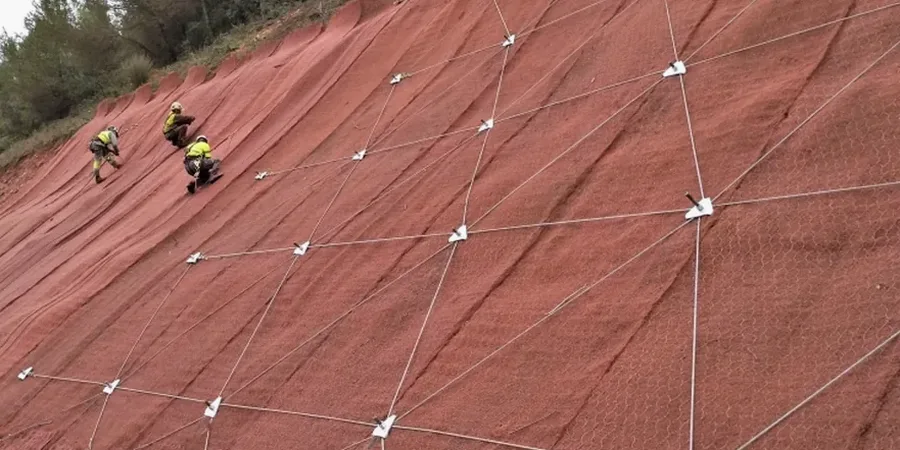
Typical technical challenges in Cape Coral
The field investigation for a Cape Coral slope stability assessment typically deploys a track-mounted CPT rig with a 20-ton capacity, equipped with a seismic module and a pore-pressure transducer — essential on canal-front lots where access for truck-mounted drill rigs is blocked by seawalls, boat lifts, and zero-lot-line setbacks. The team logs cone tip resistance, sleeve friction, and dynamic pore pressure at 2-cm intervals, producing a near-continuous profile of undrained shear strength and soil behavior type. Where the CPT refusal surface indicates cemented shell hash or limestone stringers below 25 feet, we switch to hollow-stem auger borings to retrieve Shelby tube samples for laboratory direct-shear testing. The biggest source of geotechnical risk in Cape Coral is not a deep-seated rotational failure but a compound mechanism: a shallow translational slide within the upper 6 feet of saturated silty sand that daylightes at the canal waterline, triggered by rapid drawdown during storm-pump operations. We bracket the failure envelope using both peak and fully-softened friction angles, since the latter controls once a slope has experienced even minor displacement during prior storm seasons — a condition that describes roughly 40 percent of older canal slopes in the city.
Our services
A slope stability evaluation in Cape Coral almost never stops at a single factor-of-safety calculation. Regulatory reviewers, insurance carriers, and contractors all require supporting documentation that connects the analytical model to the physical ground conditions. The three work packages below represent the typical scope for canal-front construction, stormwater pond excavation, or embankment widening.
Coupled Seepage and Stability Modeling
Transient finite-element analysis using SEEP/W and SLOPE/W that simulates a 72-hour rainfall hydrograph matched to NOAA Atlas 14 precipitation-frequency estimates for Lee County. Outputs include pore-water pressure contours at 6-hour intervals, phreatic surface envelopes, and a time-history of the critical factor of safety — revealing the exact hour when the slope reaches minimum stability.
In-Situ Strength Profiling and Laboratory Verification
Seismic CPTu soundings advanced to 60 feet or refusal, with dissipation tests at 5-foot intervals to measure the in-situ coefficient of consolidation. Companion borings retrieve undisturbed samples for consolidated-undrained triaxial testing and direct shear on the interface between fill and native Fort Thompson sand — critical where slopes incorporate geogrid reinforcement.
Rapid Drawdown and Canal-Operation Analysis
Modeling of the most severe loading condition for Cape Coral canal slopes: a 4-foot water-level drop over 6 hours during pre-storm pumping. We apply the Duncan-Wright-Strong three-stage procedure, computing effective-stress paths for each slice in the drawdown zone and flagging any slice where the mobilized stress ratio exceeds 0.85 of peak strength.
Quick answers
What slope angle is considered stable for a canal-front lot in Cape Coral?
There is no single stable angle — it depends entirely on the in-situ soil profile and groundwater conditions. For the silty sands common across Cape Coral, a 3H:1V slope with a vegetated surface and a toe drain may achieve a static factor of safety above 1.5 during dry conditions, but the same slope can drop below 1.2 under the design storm scenario unless pore-pressure relief is provided. A site-specific analysis using CPT data and transient seepage modeling is the only way to determine the appropriate geometry.
How does the Florida Building Code address slope stability for residential construction?
FBC Section 1810 requires that slopes be analyzed for both static and seismic conditions where the slope height exceeds 5 feet and the slope inclination is steeper than 2H:1V. The code references ASCE 7 for seismic coefficients and IBC 1803.5.12 for lateral soil loads. For Cape Coral specifically, the code triggers a site-specific analysis on most canal-front properties due to the proximity of the slope face to the foundation and the presence of groundwater within the zone of influence.
What is the typical cost of a slope stability analysis for a Cape Coral residential lot?
For a single-family canal-front lot in Cape Coral, the combined field investigation (CPT soundings plus one boring) and engineering analysis typically ranges from US$1,180 to US$4,060 depending on the number of cross-sections modeled, whether transient seepage is required, and the complexity of the stratigraphy. A straightforward 2D limit-equilibrium analysis with one design cross-section falls at the lower end; multi-section models with FEM verification and rapid-drawdown simulation approach the upper end.
Can existing canal slopes in Cape Coral be retrofitted if the factor of safety is too low?
Yes, and several methods are applicable to Cape Coral's conditions. Toe buttresses constructed with clean limestone fill and wrapped geotextile provide additional resisting moment without requiring space at the top of the slope. Soil nailing with corrosion-protected bars is effective where the slope face is accessible from land. For slopes with persistent high groundwater, horizontal drains installed at 15- to 20-foot spacing can lower the phreatic surface by 2 to 4 feet, often restoring the factor of safety above 1.5 without any earthwork.