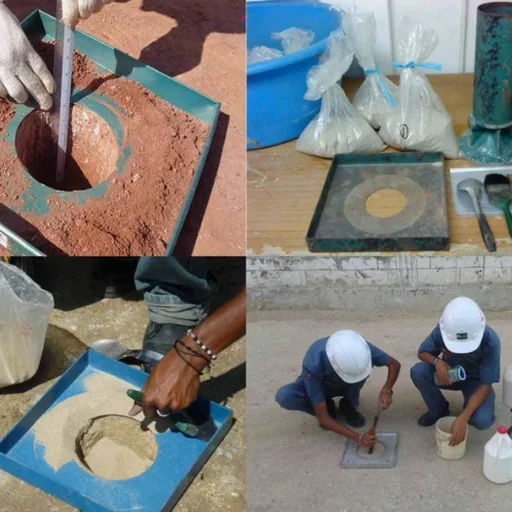
The sand cone apparatus hits the jobsite with a calibrated one-gallon jar, a precision-engineered cone, and a bag of graded Ottawa sand that has been oven-dried and weighed to the gram. In Cape Coral, where the water table sits barely three feet below finish grade across most of the canal-veined peninsula, that jar becomes the single most important quality-control tool on the entire project. The test itself is brutally simple: dig a clean hole, recover every gram of excavated soil, fill the void with sand of known density, and calculate the in-place unit weight. For the 200,000 residents spread across 120 square miles of dredged-and-filled terrain, this number determines whether a foundation pad, utility trench, or seawall backfill gets the engineer's sign-off or a re-compaction order. We run ASTM D1556 procedures daily on Cape Coral jobsites from the Yacht Club basin to the North Cape industrial corridor, and the difference between 95 and 93 percent compaction here is the difference between a structure that stays put for decades and one that starts differential settlement before the first hurricane season ends.
A one percent drop in compaction below 95 percent standard Proctor can reduce bearing capacity by as much as fifteen percent in Cape Coral's silty-sand subgrade.
Scope of work in Cape Coral
Typical technical challenges in Cape Coral
The mistake we see repeatedly in Cape Coral is the assumption that visual observation of compaction equipment — a smooth-drum roller making its passes — constitutes adequate quality control. It does not. The city's near-surface sand can look tight and well-compacted after six passes while still sitting at 89 or 90 percent of maximum dry density, particularly when the material has been placed slightly above optimum moisture and the roller is bridging over a soft layer rather than densifying it. That thin uncompacted zone, buried beneath a subsequent lift, becomes a future settlement plane. We have excavated test pits on projects where the contractor skipped field density testing for just two lifts and the cumulative settlement exceeded three inches within eighteen months of building completion. In Cape Coral's high-water-table environment, under-compacted fill also creates preferential flow paths for groundwater, accelerating internal erosion around foundation elements. The cost of a failed density test is a few hours of re-rolling and moisture adjustment; the cost of undiscovered poor compaction is structural distress, warranty claims, and potential litigation. For marine structures — seawalls, boat lifts, dock abutments — the saltwater exposure makes the margin even narrower, because any settlement that cracks a concrete cap opens a direct path for chloride attack on reinforcement.
Our services
Our Cape Coral compaction testing program covers every phase of earthwork, from subgrade verification through final lift acceptance. Each service includes the calibrated equipment, the certified report with test locations on the grading plan, and the engineering interpretation that tells you whether your fill meets the project specification.
Building Pad Compaction Testing
Grid-pattern sand cone density tests on residential and commercial building pads. We test every lift before the next one goes down, flag under-compacted zones immediately, and provide the signed compaction report that Cape Coral building officials require before foundation inspection.
Utility Trench Backfill Verification
Density testing within utility trenches for water, sewer, and storm drainage lines. We verify compaction in the pipe zone, haunch zone, and upper fill layers at the frequency specified by Cape Coral Utilities Department standards and ASTM D1556.
Seawall and Marine Structure Fill Control
Compaction verification for backfill behind seawalls, bulkheads, and boat ramp abutments. The canal-front environment demands zero-settlement performance, and we test at closer spacing to ensure no soft pockets remain before concrete placement.
Quick answers
How much does a sand cone density test cost in Cape Coral?
How many density tests does Cape Coral code require for a residential foundation pad?
Cape Coral building officials generally require a minimum of one field density test per 2,500 square feet per compacted lift, with a minimum of four tests for any pad regardless of size. For a typical 2,000-square-foot home, that translates to four tests per lift. If the fill is placed in two lifts, eight tests total are required. Additional tests may be needed in areas where visual inspection or previous results suggest marginal compaction.
Can you use a nuclear density gauge instead of the sand cone in Cape Coral?
Nuclear density gauges are permitted under ASTM D6938 and can provide faster results on large sites, but they require a moisture calibration specific to Cape Coral's shell-bearing sands, and the gauge operator must hold a Florida Bureau of Radiation Control license. We prefer the sand cone method for most Cape Coral projects because it eliminates calibration drift issues in the coastal humidity, requires no radioactive materials license, and produces a direct physical measurement that is easier to defend if test results are challenged by a third-party inspector.
What happens if a compaction test fails?
When a sand cone test returns a density below the project specification — typically 95 percent of the maximum dry density from the Proctor curve — we mark the failed location on the grading plan immediately and notify the earthwork contractor. The standard remedy is moisture adjustment if the material is too dry or too wet, followed by additional roller passes and re-testing. If the failure is due to unsuitable fill material, the affected lift must be removed and replaced. We stay on site until the re-test passes, so the project does not lose a day waiting for a follow-up visit. More info.