With over 400 miles of canals and a water table that sits just a few feet below the surface, Cape Coral presents a unique challenge for pavement engineers. The city's sandy soils, typical of the Matlacha Formation, often require precise subgrade assessment before any road or parking lot project moves forward. A laboratory CBR test provides that critical value, measuring the soil's resistance to penetration under controlled moisture and density conditions. We run soaked CBR specimens to replicate the worst-case scenario that Cape Coral's subtropical wet season (averaging 55 inches of rain annually) imposes on pavements. The result feeds directly into the AASHTO 1993 pavement design equation, determining the structural number and layer thicknesses needed. For projects near the Caloosahatchee River or in the expanding Northwest Cape, we often pair CBR data with grain size analysis to confirm fines content, and Proctor compaction tests to establish the moisture-density relationship for the same borrow material.
A laboratory soaked CBR value reflects the pavement's future, not just the soil's condition on the day of construction.
Scope of work in Cape Coral
Typical technical challenges in Cape Coral
The Florida Building Code (FBC 2023, Section 1804) and the Cape Coral Public Works standards require a geotechnical investigation for any public right-of-way pavement or commercial development exceeding 5,000 square feet. The laboratory CBR test is the backbone of that investigation for flexible and rigid pavement design. Skipping the soaked CBR leads to under-designed sections that rut within two wet seasons—a costly outcome visible in older commercial strips along Pine Island Road. The Cape's flat topography (average elevation 5 feet above sea level) means positive drainage is minimal, keeping the subgrade near saturation for months after the summer rains. A CBR value of 3% versus 8% can double the required aggregate base thickness. We have seen projects where the design CBR was assumed at 10%, but lab testing on soaked samples yielded 4%, prompting a complete redesign of the pavement section before construction began. That early correction saved the developer over six figures in future maintenance liability.
Our services
Our Cape Coral laboratory provides a complete workflow for pavement subgrade characterization, from sample receipt to a signed report. Each service below supports the final design CBR value used by your civil engineer.
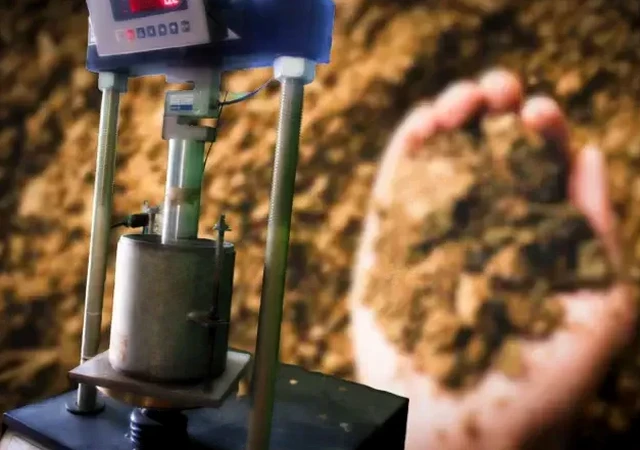
Soaked Laboratory CBR
The standard test for Cape Coral projects. Specimens compacted to specified density, submerged for 96 hours, and penetrated at 0.05 in/min. Includes swell measurement during soaking and a complete load-penetration curve.
Unsoaked (As-Compacted) CBR
For projects with a guaranteed water table depth or internal drainage (e.g., parking garages). Provides the immediate post-construction CBR value without moisture conditioning.
Modified Proctor (ASTM D1557)
Establishes the maximum dry density and optimum moisture content for the same soil used in CBR specimens. Essential for quality control during compaction on site.
CBR Correlation & Pavement Thickness Design
Our report includes the design CBR value at 0.1-inch penetration and, upon request, AASHTO structural number calculations for flexible and rigid pavement sections based on Cape Coral traffic loads.
Quick answers
What is the standard turnaround time for a laboratory CBR test in Cape Coral?
Standard turnaround is five to seven business days from sample receipt. The 96-hour soaking period required by ASTM D1883 accounts for most of this time. We offer an expedited three-day service for unsoaked (as-compacted) CBR tests when project schedules demand faster results.
How much does a laboratory CBR test cost for a Cape Coral project?
How many CBR test points do I need for my pavement design?
The number depends on project size and soil variability. For a single commercial lot in Cape Coral with uniform soils, a three-point CBR curve (three specimens) is standard. For a linear project like a roadway extension through the North Spreader Canal area, we recommend one three-point CBR per distinct soil type encountered in the test pits, typically every 500 to 1,000 linear feet.
Can I use a field DCP test instead of a laboratory CBR?
Field DCP testing provides a quick in-situ indication but does not replace the laboratory CBR for final pavement design in Cape Coral. The DCP cannot simulate the long-term soaked condition that governs performance here. The Florida Building Code and Cape Coral standards accept DCP for preliminary investigations, but final design CBR values must be verified by laboratory testing per ASTM D1883 to account for seasonal moisture changes in the subgrade.