Cape Coral grew fast. The master-planned grid of saltwater canals — over 400 miles of them — reshaped the surface before any building started. That fill history matters. Excavated spoil from canal cuts became the pad material for thousands of residential lots, creating a layer of reworked sand, shell fragments, and silt with unpredictable compaction. An exploratory test pit cuts through that top layer in minutes. It exposes the contact between fill and natural strata, reveals buried organic lenses from the pre-development flatwoods, and lets the engineer log soil fabric with a hand lens and pocket penetrometer — data no boring log from a split-spoon sample can match. In Cape Coral’s low-elevation terrain, where the water table sits just 2 to 5 feet below finished grade, direct observation saves assumptions. SPT drilling gives you N-values at depth, but the test pit tells you what’s happening between boreholes in the critical zone where footings, slabs, and utilities interact with backfill.
A test pit is the only method that lets you run your hand across the actual contact between fill and natural ground — and in Cape Coral, that contact controls everything.
Scope of work in Cape Coral
Typical technical challenges in Cape Coral
The near-surface geology in Cape Coral is Fort Thompson Formation limestone overlain by Holocene quartz sand and variable artificial fill. Sulfate levels in the shallow groundwater can exceed 1500 ppm, a condition that triggers Type V cement requirements per ACI 318 for concrete in contact with soil. An exploratory test pit that misses a thin gypsum crust or an organic silt lens can lead to slab distress within five years. The bigger risk is differential settlement across the fill-natural soil boundary — a condition invisible to deep borings alone but immediately obvious when the pit wall exposes a wavy, irregular contact with thickness variation of 12 inches or more across a 20-foot trench length. In the canal-front lots that define Cape Coral’s premium real estate, undocumented buried debris — old seawall remnants, construction spoils, concrete washout — hides just below the grass line. A test pit finds it before the excavator does, and before the change order lands on the owner’s desk.
Our services
An exploratory test pit program in Cape Coral is never just a hole in the ground. It answers specific questions about fill quality, utility conflicts, water table depth, and the soil profile that standard penetration tests cannot resolve at the surface. Our field teams combine the pit excavation with companion testing that turns visual observations into contract-ready numbers.
Test Pit Excavation and Stratigraphic Logging
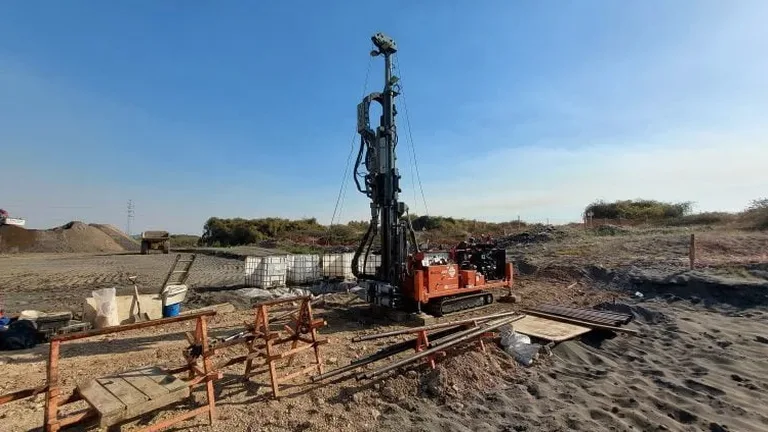
Machine-excavated pit with vertical face preparation, continuous SPT sampling at the base, and detailed visual-manual logging per ASTM D2488. Includes identification of fill-natural contacts, organic layers, shell horizons, and debris. Delivered with a signed stratigraphic column, photo log, and GPS-referenced location plan.
In-Situ Density and Moisture Verification
Sand cone density testing at the base and mid-depth of the test pit to verify compaction of fill materials. Results reported as dry density and relative compaction against laboratory Proctor maximum values. This test closes the gap between visual assessment and quantitative acceptance criteria for slab support and utility backfill.
Quick answers
How much does an exploratory test pit cost in Cape Coral?
What depth can a test pit reach before the water table becomes a problem?
In most parts of Cape Coral the groundwater table sits between 2 and 5 feet below grade, especially during the wet season from June through September. Test pits deeper than 5 feet usually encounter water inflow that requires dewatering with a trash pump or rescheduling for the dry winter months. We document the water level at excavation and, when possible, after a 24-hour stabilization period.
Is a test pit a substitute for SPT drilling?
No — a test pit and an SPT boring answer different questions. The test pit gives you a continuous visual profile of the upper 5 to 8 feet, ideal for assessing fill quality, organic content, and buried debris. SPT drilling provides blow-count data and samples from deeper strata that control bearing capacity and settlement. Most Cape Coral projects use both: test pits for the shallow fill zone, and SPT borings for the underlying sand and limestone.
What safety measures apply to test pit excavation?
We follow OSHA 29 CFR 1926 Subpart P for all excavations. Pits deeper than 5 feet require benching, sloping, or trench shield protection before personnel enter. Our crews carry out a daily competent-person inspection, document soil classification for trench stability, and keep spoil piles at least 2 feet from the edge. No one enters a pit that has not been checked for hazardous atmosphere if any indication of organic decay or buried material exists.
Can a test pit confirm if my fill is compacted enough for a slab-on-grade?
Yes — a test pit combined with a sand cone density test at the pit base gives you a direct measurement of in-place density and relative compaction. We compare that value to the laboratory Proctor maximum (ASTM D698 or D1557) for the same material. If the fill tests below 95 percent of maximum dry density, the report flags it for re-compaction or over-excavation before slab construction proceeds.