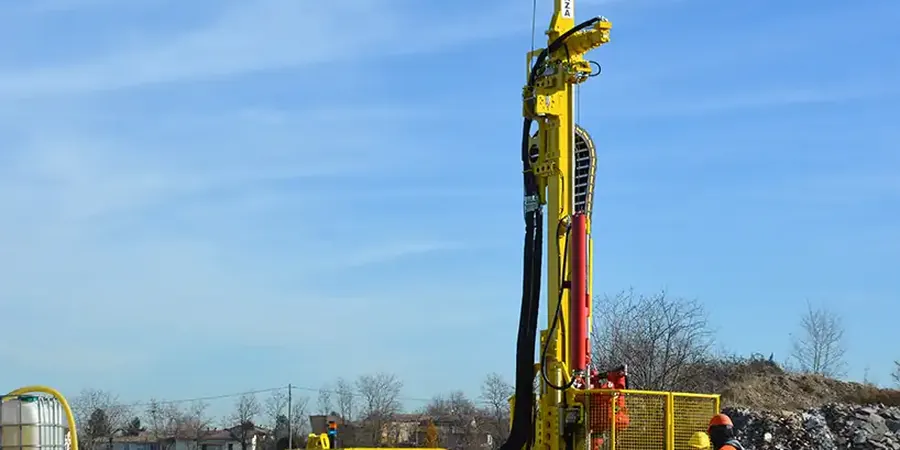
A three-story medical office going up off Del Prado Boulevard hit refusal at 12 feet in what the driller logs initially called caprock. Turned out to be a dense cemented shell hash layer common in this part of Lee County. That's the kind of subsurface surprise you don't catch with a hand auger. Standard Penetration Testing (SPT) runs a 140-pound hammer dropping 30 inches to drive a split-spoon sampler, recording blow counts every 6 inches. The N-value you get is the raw number contractors, geotechs, and structural engineers use every day to size footings and check liquefaction potential. In Cape Coral, where the water table often sits barely 4 to 6 feet down and limestone floaters show up unannounced, the SPT gives you repeatable data tied directly to ASTM D1586-18 and the site classification tables in ASCE 7-22 Chapter 20. When we mobilize the CME-75 rig to a Cape Coral lot, we correlate SPT results with CPT soundings to refine stratigraphy, and run companion grain-size analyses on the split-spoon samples to nail down the Unified Soil Classification.
In Cape Coral's canal-veined geology, an uncorrected SPT N-value of 4 in loose sand at 8 feet can mean the difference between a spread footing and a pile-supported mat.
Scope of work in Cape Coral
Working video
Typical technical challenges in Cape Coral
The single biggest headache we see on Cape Coral jobs is misinterpreting SPT refusal on thin cemented layers. A driller hits 50 blows in 4 inches of shell hash at 18 feet depth, calls it end of boring, and the engineer designs a shallow footing. Problem is, that cemented crust might be sitting on 20 feet of loose sand with an N-value under 10, and when the hurricane storm surge pushes the water table up, the effective stress drops and the foundation settles differentially. We've seen it in the southwest Cape near the Matlacha Pass area more times than anyone likes to admit. Another risk is running SPT without correction for overburden pressure in sand deeper than about 30 feet. A raw N of 30 at 45 feet in clean sand doesn't mean the same thing as N=30 at 10 feet; you apply the Liao & Whitman (1986) overburden correction to get N1,60, which is what you need for the Youd-Idriss (2001) liquefaction triggering analysis. The IBC 2021 Section 1803 requires a site-specific liquefaction study where the groundwater table is within 50 feet of grade and the mapped spectral accelerations exceed certain thresholds, and much of coastal Lee County falls squarely in that box.
Our services
Every SPT boring we complete in Cape Coral feeds directly into the deliverables the structural engineer, the P.E. of record, and the building department want to see before they stamp the foundation permit.
SPT-Based Bearing Capacity and Settlement
We convert field N60 values to allowable bearing pressure using Meyerhof or Bowles correlations, with settlement estimates based on Schmertmann or Hough methods. The report includes a factored bearing capacity table organized by footing width and embedment depth, ready for structural design input.
Liquefaction Screening and Site Class
Using corrected N1,60 values and fines content from lab testing, we run the NCEER simplified procedure to calculate factor of safety against liquefaction at each critical depth. The deliverable includes the ASCE 7 site class letter, the seismic design coefficients SMS and SM1, and a liquefaction potential index map for the project footprint.
Quick answers
How many SPT borings does Cape Coral building department typically require for a single-family home?
Most residential plans reviewers in Lee County ask for a minimum of one boring per 2,500 square feet of building footprint, with at least one boring at each corner of the proposed foundation. For a typical 2,000-square-foot Cape Coral canal-front home, that usually means two borings to 25 feet depth minimum. The exact number depends on lot history: if the parcel was filled with dredge material from the canal system, the reviewer may request a third boring to map the fill thickness. Always check the current Cape Coral Community Development requirements before mobilizing.
What does the SPT N-value actually tell me about the soil?
The N-value is the sum of blows needed to drive the split-spoon the last 12 inches of an 18-inch penetration test. It correlates with relative density in sands and consistency in clays. An N between 0 and 4 in sand means very loose; 4 to 10 loose; 10 to 30 medium-dense; 30 to 50 dense; and above 50 very dense or refusal. In clays, N below 2 is very soft, 2 to 4 soft, 4 to 8 medium-stiff, 8 to 15 stiff, 15 to 30 very stiff, and above 30 hard. The N-value feeds directly into bearing capacity equations, settlement predictions, and liquefaction triggering curves.
How much does an SPT boring program cost in Cape Coral?
How deep should SPT borings go for a commercial building in Cape Coral?
The IBC 2021 Section 1803.5.2 requires borings to extend to a depth where the stress increase from the foundation is less than 10 percent of the existing effective overburden pressure, or to refusal on bedrock, whichever comes first. For a commercial building with column loads in the 200-400 kip range in Cape Coral, that typically translates to 40 to 60 feet below grade. If deep limestone is not encountered by 60 feet and the N-values are still below 30, we coordinate with the structural engineer to decide whether to go deeper or switch to a deep foundation design.