Cape Coral sits on a labyrinth of canals carved into the Tamiami Formation, where sandy limestone and shell-bearing sediments alternate with zones of soft marl and dissolution cavities. The water table here often rises to within 18 inches of the surface during the wet season, which means any anchor system must perform reliably under submerged, slightly acidic groundwater conditions that accelerate corrosion of unprotected steel. We apply FHWA ground anchor guidelines for permanent tiebacks in this environment, specifying double-corrosion protection and full-length encapsulation when tendons pass through the vuggy limestone zones that characterize Cape Coral's subsurface. For projects near the Caloosahatchee River or the city's 400-mile canal network, the interaction between fluctuating hydrostatic pressure and anchor bond stress is not a footnote; it drives the entire design load philosophy and the selection of post-tensioning sequences.
Anchor bond stress in Cape Coral limestone can drop from 200 psi to under 40 psi within fifty lateral feet due to dissolution voids—spatial mapping is not optional.
Scope of work in Cape Coral
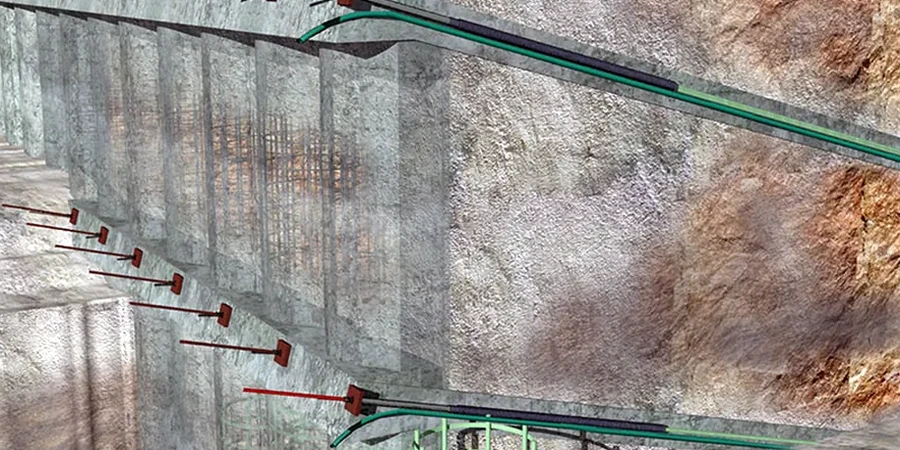
Typical technical challenges in Cape Coral
Limestone dissolution in Cape Coral follows preferential flow paths that cannot be predicted from a single boring, and undetected voids within the bond zone will cause sudden tension loss during lock-off or, worse, progressive creep failure under sustained hurricane wind loads. The combination of warm, acidic groundwater and high dissolved CO₂ creates a corrosive environment where unprotected tendon steel can lose 2 to 5 mils per year, compromising a supposedly permanent anchor within a decade if sheath continuity is not verified post-installation. Anchor systems that rely on gravity-grouted bond zones without pressure injection routinely underperform here because the annular space fills incompletely in vuggy rock, leaving sections of tendon unbonded and susceptible to localized pitting. When anchors penetrate the freshwater-saltwater interface along the Caloosahatchee corridor, differential aeration cells accelerate corrosion even through minor sheath defects, requiring epoxy-coated or galvanized strand beyond standard encapsulation. A single failed anchor in a soldier pile wall can redistribute load to adjacent anchors beyond their ultimate capacity, initiating a cascading failure mode that Florida's hurricane exposure makes particularly unforgiving.
Our services
Anchor design in Cape Coral spans applications from sheet pile canal walls to foundation uplift resistance in high-wind zones. The two service categories below reflect the distinct technical challenges of this environment.
Active (Post-Tensioned) Anchor Design
Post-tensioned anchors apply a deliberate compressive force to the retained soil mass or structure before external loads are imposed, eliminating initial movement. In Cape Coral, we design active systems for deep excavations adjacent to canals where lateral displacement must be held below 0.25 inches to protect adjacent bulkheads. Each design includes a detailed lock-off load calculation that accounts for wedge seating loss in the anchor head and elastic shortening of the tendon under transfer, verified through lift-off testing on 5% of production anchors. We specify cement grout with a water-cement ratio not exceeding 0.40, often with silica fume admixture at 8% by cement weight to reduce bleed and improve sulfate resistance in Cape Coral's mineralized groundwater.
Passive Anchor and Soil Nail Design
Passive anchors develop resistance through ground deformation rather than applied prestress, making them suitable for temporary excavation support and slope stabilization in Cape Coral's sandy overburden. We size the grout bulb diameter and bond length based on SPT N-values correlated to FHWA soil-grout interface friction, typically yielding unit bond strengths of 3 to 8 psi in loose-to-medium silty sand above the limestone. Where passive anchors must penetrate the weathered limestone contact, we transition to a self-drilling hollow bar system to maintain hole stability through the raveling zone and ensure continuous grout encapsulation across the soil-rock interface.
Quick answers
What is the typical cost range for anchor design and installation in Cape Coral?
How does Cape Coral's high water table affect anchor bond capacity?
Submerged conditions reduce effective stress in granular soils, lowering soil-grout interface friction by 15 to 30% compared to dry conditions. In limestone, the water table matters less for bond strength but significantly influences corrosion protection requirements. We design for the highest anticipated water level during the anchor's service life, typically the September wet-season peak, and specify post-grouting through tube-a-manchette sleeves when bond zones fall within the zone of water table fluctuation where cyclic wetting-drying degrades grout integrity over time.
What proof testing is required for permanent anchors in Florida?
Permanent anchors in Florida follow PTI DC35.1 acceptance criteria: each production anchor undergoes a performance test to 133% of the design load, held for a minimum of 10 minutes while recording creep at intervals of 1, 2, 3, 4, 5, 6, and 10 minutes. The creep rate must not exceed 0.04 inches per log cycle of time for soil anchors or 0.02 inches for rock anchors. We also require lift-off testing on 5% of anchors between 24 and 72 hours after lock-off to verify that seating losses and tendon relaxation have not reduced the residual load below the specified lock-off value.